








UKIYO · Journal
Postpartum Hair Loss NZ: Timeline, Treatment and What Helps
By Codie Hair, Owner, UKIYO Wānaka
Shop this article
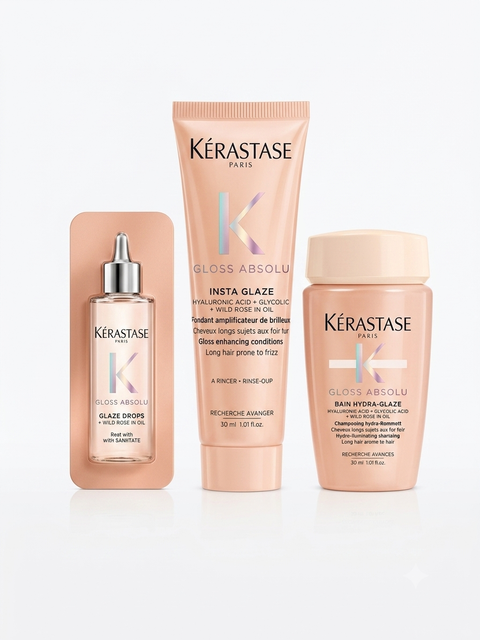
The exact products our stylists recommend in this piece — genuine salon stock, shipped NZ-wide from Wānaka. Orders over $59 get a free Kérastase travel-size gift at checkout.



Free NZ shipping over $75.
Short answer: Postpartum hair loss is common and usually temporary. It tends to start two to four months after birth, is often heaviest around four months, and settles for most people within six to twelve months. Nothing stops it entirely. What helps is a cut that suits where your hair is right now, gentle handling, and a strengthening routine like Kérastase Genesis so less of what you keep snaps off. See your GP if it's still heavy after a year or you notice bald patches.
Updated November 2026. Prices are our live online prices.
We see this at the basin all the time, usually from someone a few months out from having a baby who has just pulled a handful of hair out of the shower drain. It's frightening. Here's what we tell clients, what we'd actually spend money on, and when it's worth a trip to the doctor.
Why does postpartum hair loss happen?
During pregnancy, hormone levels keep a lot of hair in its growing phase. Hair you would normally have shed hangs on, which is why so many people say their hair was the best it's ever been. After the birth, hormones drop and that held-over hair moves into the shedding phase together. Months of normal shedding arrive in a few weeks. Doctors call it telogen effluvium. The hair coming out is hair you were always going to lose. It's just leaving at once.
The postpartum hair loss timeline
| When | What usually happens |
|---|---|
| 0 to 2 months | Hair often still feels thick |
| 2 to 4 months | Shedding starts, often suddenly. More in the brush, drain and pillow |
| Around 4 months | Often the heaviest point. Temples and hairline can look thinner |
| 6 to 12 months | Shedding slows. Short regrowth appears along the hairline and part |
| 12 months+ | Most people are back to normal. If you're not, see your GP |
Is 4 months postpartum hair loss normal?
Yes. Four months is right in the middle of the usual window, and it's when most clients first mention it to us. Those short, fluffy bits that show up around your face a few months later are regrowth. They stick up and drive people mad, but they're good news.
Postpartum hair loss treatment: what actually helps?
Honestly, no shampoo, serum or salon treatment stops postpartum shedding. Anyone promising that is overselling. What you can do is look after the hair you have, cut down on breakage so you're not losing extra on top of the shedding, and style it so it looks fuller while you wait.
- Be gentle. Detangle with a wide-tooth comb from the ends up, ideally with conditioner in. Fragile hair snaps most when it's wet.
- Loosen the ponytail. Tight elastics and the same high bun every day pull at the hairline, which is exactly where the shedding shows.
- Turn the heat down. Lower heat and a heat protectant every time.
- Look after yourself. Sleep and food are hard with a newborn, we know. If you're worried about iron or thyroid, a blood test is quick.
Which postpartum hair products are worth considering for thinning areas?
This is what we'd spend money on, in order.
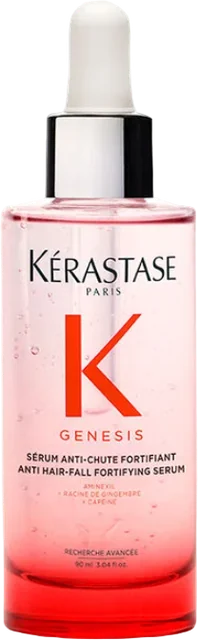
- Kérastase Genesis Sérum Anti-Chute Fortifiant ($78.50). A daily scalp serum for hair fall caused by breakage, made with ginger root and edelweiss. Kérastase says it reduces breakage by up to 84%. Part your hair, apply along the parts, massage in, don't rinse.
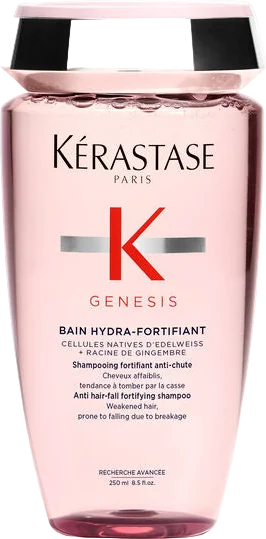
- A Genesis shampoo. Bain Hydra-Fortifiant ($51.00) if your roots get oily, Bain Nutri-Fortifiant ($51.00) if your hair runs dry. Not sure? Try the 30ml travel size ($12.91) first.
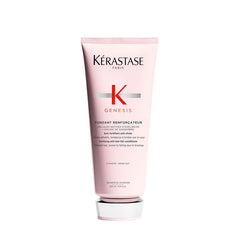
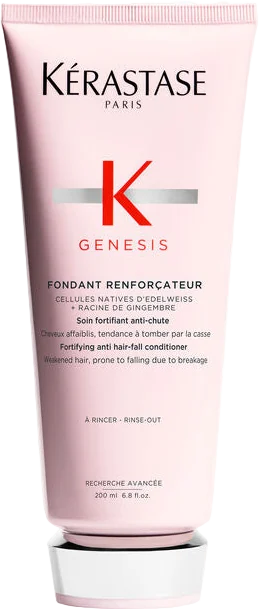
- Genesis Fondant Renforçateur ($63.00). A light conditioner, so detangling causes less snapping.
- Something for root volume. Sebastian Volupt Thickify Mousse ($49.24) on damp roots makes thin patches much less obvious.
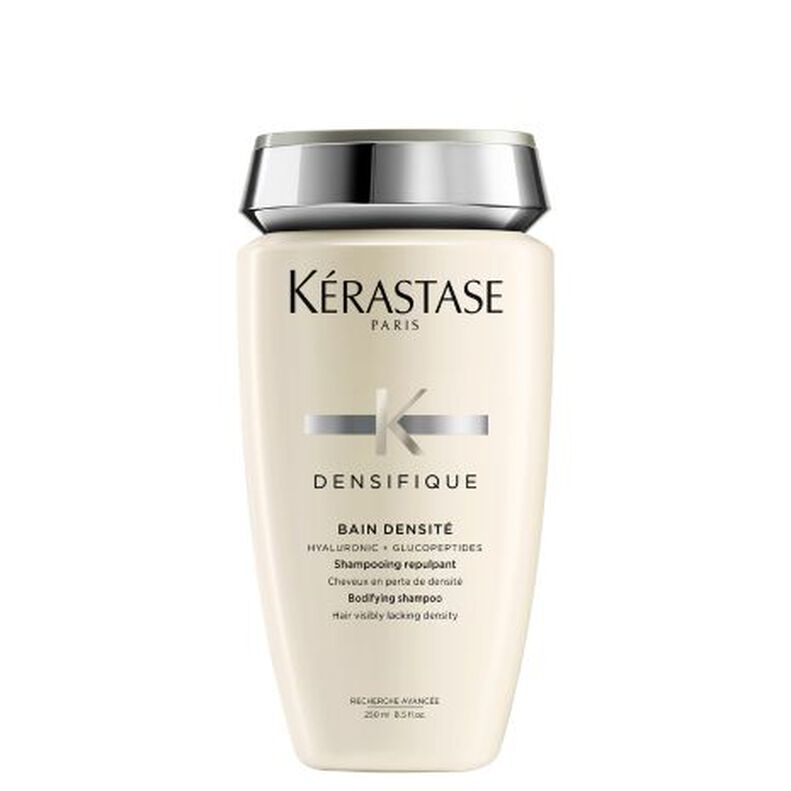
If nothing much is falling out any more but your hair feels finer than before, Densifique Bain Densité ($57.12) is the better fit than Genesis. We go deeper in the Kérastase Genesis guide.
Two ways to build a postpartum routine: choose by budget
| Step | Sebastian (lower price) | Kérastase (premium) |
|---|---|---|
| Wash | Volupt Max Shampoo $50.12 | Genesis Bain Hydra-Fortifiant $51.00 |
| Condition | Volupt Max Conditioner $50.12 | Genesis Fondant $63.00 |
| Scalp | No Sebastian equivalent | Genesis Serum $78.50 |
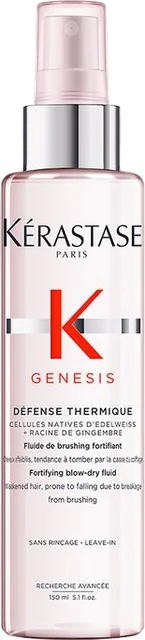
| Volume | Volupt Thickify Mousse $49.24 | Genesis Défense Thermique $63.00 (heat protection for fragile hair) |
They genuinely differ here. Sebastian has no hair-fall range, so the Sebastian route is about making the hair you have look fuller. Genesis is built for hair that's breaking and shedding. If budget is tight, the Genesis serum plus the Sebastian wash is a sensible middle ground.
How to style through it
A fresh cut is the single most useful thing a salon can do while you're shedding. Long, thin ends make everything look sparser. A shape with soft layers, or taking a few centimetres off, makes the same amount of hair look thicker. Ask for a cut that's easy to dry, because you won't have time for a 40-minute blow-dry.
- Volume at the roots, lightness through the lengths. Mousse at the root, light conditioner on the ends only.
- A side part hides a thinner temple better than a centre part.
- Soft face-framing pieces blend the regrowth when it comes through.
Want the whole routine? The Sebastian Volupt Routine Bundle puts the shampoo, conditioner, spray gel and Thickify mousse in one set, for less than buying them separately. Or browse the full Sebastian Volupt range.
For more on making fine hair look fuller, see our best products for fine hair guide.
Postpartum dandruff and scalp changes
Hormone shifts can change your scalp as well as your hair. Some people find it oilier for a while, others get flakes for the first time. A gentle anti-dandruff wash like Kérastase Symbiose Bain Crème ($57.12) is made for dry scalps prone to flaking, and you can alternate it with your Genesis shampoo. If the scalp is red, sore or the flakes don't settle after a few weeks, that's one for the GP or pharmacist.
Postpartum hair loss bald patches: when to see a doctor
Postpartum shedding is overall thinning, mostly around the temples and hairline. See your GP if you have round bald patches, if heavy shedding carries on past twelve months, if your scalp is itchy, sore or scaly, or if you have other symptoms like tiredness or weight changes. Postpartum thyroid changes and low iron are common and treatable. Our why is my hair falling out guide covers the other common causes, and the thinning hair guide covers products for longer-term density loss.
Feeling flat about your hair right now? Come in for a cut that works with the shedding. Book online or call us on 03 443 1040.
Why buy from UKIYO
We're working stylists at UKIYO on Helwick Street in Wānaka, and these are the products we use on clients every day. Everything we sell is genuine salon stock, bought direct from the brands' New Zealand distributors. Free NZ shipping over $75, or pick up in the salon at 28 Helwick St.
Questions we get asked
When does postpartum hair loss start and stop?
It usually starts two to four months after birth, is often heaviest around four months, and settles for most people by six to twelve months.
Is 4 months postpartum hair loss normal?
Yes. Four months is right in the usual window and is often the heaviest point. Short regrowth around the hairline a few months later is a good sign.
What is the best postpartum hair loss treatment?
Nothing stops postpartum shedding completely. A gentle routine, less heat and tension, and a strengthening range like Kérastase Genesis help reduce extra breakage while it settles.
Is Kérastase good for postpartum hair loss?
Kérastase Genesis is made for hair fall caused by breakage, which is why we recommend it to new mums. The daily Genesis serum is the step that matters most.
Can I use the Genesis serum while breastfeeding?
Check with your GP or midwife before using any new scalp treatment while breastfeeding, and bring the box so they can see the ingredients.
Can postpartum hair loss cause bald patches?
Postpartum shedding is usually overall thinning, often at the temples. Round bald patches are a different pattern, so see your GP.
Should I cut my hair after having a baby?
Often, yes. A shape with soft layers, or taking some length off, makes thinner hair look fuller and is easier to manage with a newborn.
Keep reading: Why Is My Hair Falling Out? Normal Shedding vs When to See a GP
分享
UKIYO
Shop this article
The exact products our stylists recommend in this piece — add to cart and we'll ship NZ-wide.
11% off your first order with code WELCOME11. Free NZ shipping over $75.
阅读更多
Balayage vs Foils vs Babylights: Which Should You Book?
Short answer: Balayage is hand-painted, soft at the root and grows out gently, so you can go three to four months between visits. Foils (highlights) are woven and wrapped, lift brighter and more ev...
Menopause Hair Loss and Perimenopause Hair Changes: A Stylist's Guide
Short answer: Falling oestrogen through perimenopause and menopause commonly makes hair finer, less dense at the part and crown, drier and more wiry, and slower to grow. A cut built for density, so...